Finishing a manuscript is a major achievement, but turning that manuscript into a professionally published book involves several important decisions. If you are researching how to publish a book in Australia, you essentially have two main options: traditional publishing or self-publishing.
Both routes can produce a professional book, but they differ in costs, creative control, timelines, distribution and author responsibilities. You will also need to consider editing, book design, ISBNs, printing, distribution and Australian legal deposit requirements.
This guide explains the book publishing process in Australia step by step, including how to approach publishers, prepare your manuscript, self-publish your book and get it ready for readers.
How Does Publishing a Book in Australia Work?
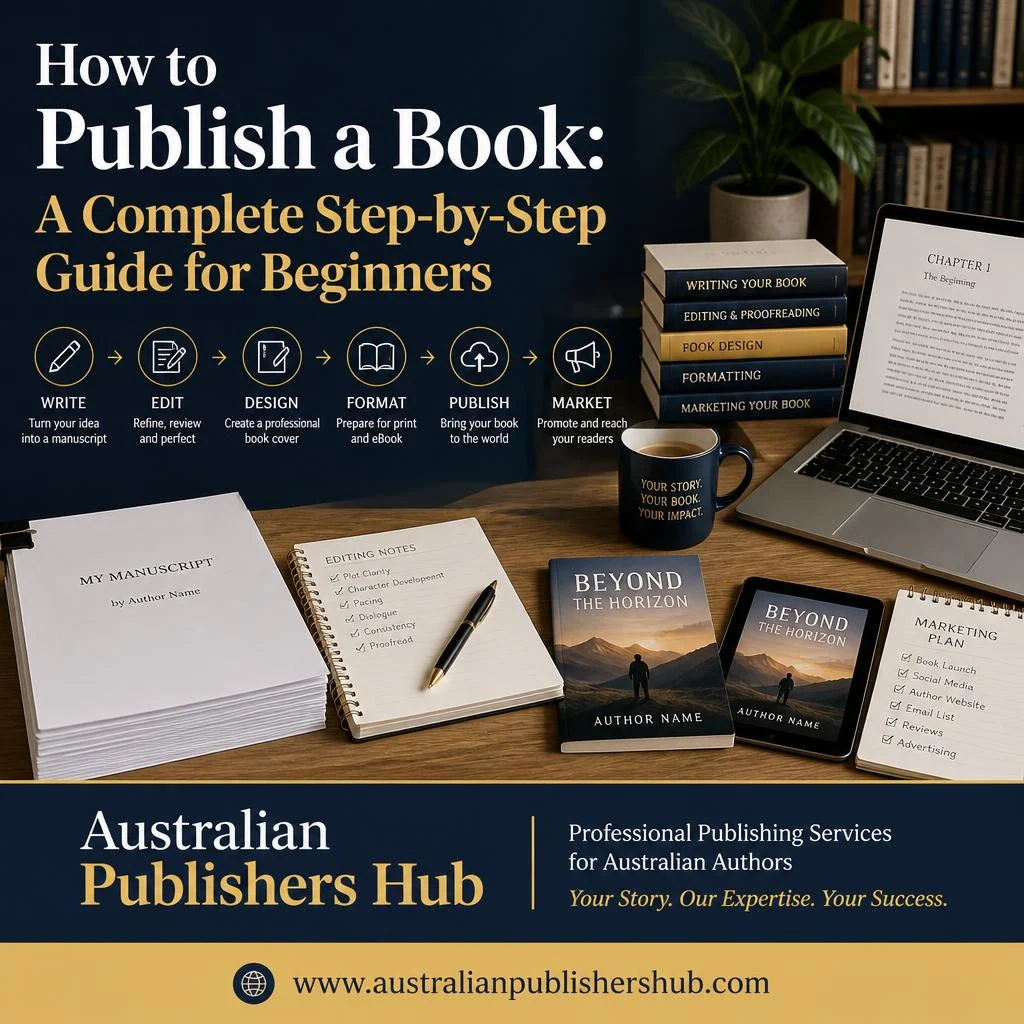
The process of publishing a book in Australia can generally be divided into seven stages:
Complete and revise your manuscript.
Choose traditional publishing or self-publishing.
Edit and proofread the manuscript.
Prepare the cover and interior design.
Arrange publication details such as ISBNs where required.
Publish, print and distribute the book.
Promote the book and meet applicable legal deposit obligations.
The exact process depends on which publishing route you choose.
With traditional publishing, the publisher generally manages much of the production process after accepting your manuscript. With self-publishing, you coordinate these stages yourself or work with Australian Publishers Hub for professional publishing support.
Traditional Publishing vs Self-Publishing in Australia
Before approaching book publishers in Australia or investing in publishing services, decide which route best suits your goals.
Factor | Traditional Publishing | Self-Publishing |
Manuscript acceptance | Publisher decides | Author decides |
Upfront production costs | Generally managed by publisher | Usually paid by author |
Creative control | Shared with publisher | Greater author control |
Editing and design | Publisher generally coordinates | Author arranges |
Timeline | Based on publisher schedule | Greater author control |
Distribution | Publisher manages agreed channels | Author/service/platform manages |
Marketing | Varies by publishing agreement | Primarily author-led |
Neither approach is automatically better.
Traditional publishing may appeal to writers who want an established publishing team and industry distribution. Self publishing in Australia may suit authors who want greater control over production, design, pricing and release timing.
How to Get a Book Published in Australia Through a Traditional Publisher
If you are wondering how to get a book published in Australia through an established publishing house, preparation is essential.
Do not simply send your manuscript to every publisher you can find. Instead, make the manuscript publication-ready and identify publishers that genuinely fit your genre, subject and intended readership.
1. Finish and Refine Your Manuscript
Before submitting your book, make the manuscript as strong as possible.
For fiction, this usually means completing the entire manuscript and reviewing elements such as:
Plot and structure
Character development
Pacing
Dialogue
Consistency
Grammar and spelling
Readability
Nonfiction requirements can vary because some publishers may consider detailed proposals rather than completed manuscripts.
Depending on your manuscript, professional preparation can include developmental editing, copyediting and proofreading. Authors who need additional assistance can consider professional book editing and publishing support from Australian Publishers Hub.
2. Research Australian Book Publishers
Understanding how to find a publisher in Australia starts with targeted research.
Different Australian book publishers specialise in different genres, audiences and markets. A publishing company specialising in children's books, for example, may not be suitable for an academic nonfiction manuscript or adult thriller.
When researching publishers, check:
Genres they currently publish
Recently published books
Submission requirements
Whether unsolicited manuscripts are accepted
Whether submissions are open throughout the year
Whether a literary agent is required
Required manuscript format
The Australian Society of Authors provides resources for Australian writers covering publishing, contracts and professional writing matters.
3. Prepare Your Submission Package
Another important part of learning how to submit a book to a publisher in Australia is understanding submission requirements.
There is no single submission format used by every publisher.
Depending on the publisher and type of book, you may be asked to provide:
A query or cover letter
A synopsis
Sample chapters
Complete manuscript
Author biography
Nonfiction proposal
Intended readership information
Comparable titles
Market positioning
Always follow the individual publisher's instructions.
If a publisher requests three sample chapters, sending the complete manuscript instead does not necessarily strengthen your submission. Following instructions demonstrates professionalism.
4. Decide Whether You Need a Literary Agent
Not every Australian author needs a literary agent.
Some publishers accept manuscripts directly from writers, while others primarily work through literary agents.
A literary agent may help with:
Identifying suitable publishers
Manuscript submissions
Publishing negotiations
Contract discussions
Career guidance
Check individual publisher submission policies before deciding whether representation is necessary.
5. Review the Publishing Contract Carefully
Receiving a publishing offer is exciting, but authors should understand the agreement before signing it.
Pay attention to areas such as:
Publishing rights
Territory
Print and digital formats
Royalties
Payment terms
Contract duration
Rights reversion
Author responsibilities
Editing and approval provisions
The Australian Society of Authors also provides information and resources relating to publishing agreements and authors' professional interests.
Seek appropriate professional advice if you do not understand important contractual terms.
How to Self Publish a Book in Australia
If you are researching how to self publish a book in Australia, remember one important principle:
Self-publishing means you become responsible for many of the functions traditionally handled by a publisher.
This provides greater control, but it also means coordinating editing, design, formatting, publication, printing and distribution yourself or hiring professionals to handle individual stages.
Step 1 – Prepare the Final Manuscript
Do not treat your first completed draft as the final book.
Complete substantial revisions before formatting and designing the manuscript. Making major textual changes after typesetting can increase production work and introduce new errors.
Depending on the book, preparation may include:
Developmental editing
Copyediting
Proofreading
Fact-checking
Final author review
If professional assistance is required, Australian Publishers Hub can be used as the main internal destination for information about available publishing support.
Step 2 – Create a Professional Book Design
Readers often form an immediate impression from the presentation of a book.
A professionally prepared book may require:
Cover design
Interior layout
Typesetting
Typography
Chapter formatting
Appropriate margins
Trim-size selection
Ebook formatting
The design should also reflect the genre.
A children's book, memoir, business book, romance novel and academic publication should not all follow the same visual conventions.
Step 3 – Understand ISBN Requirements
An ISBN, or International Standard Book Number, is an identifier used for books and related publications.
In Australia, ISBNs are provided through Thorpe-Bowker Identifier Services, the Australian ISBN agency.
Authors should determine which ISBN requirements apply to their intended formats and distribution arrangements before publication.
An ISBN should not be confused with copyright or legal deposit. These are separate concepts with different purposes.
Step 4 – Choose Print, Ebook or Both
Modern self publishing Australia options give authors considerable flexibility.
You might publish through:
Print-on-demand
Short print runs
Offset printing
Ebook publishing
Print and digital formats together
Print-on-demand can reduce the need to purchase and store large quantities of books because copies can be produced as required.
When comparing book printing Australia options, consider:
Cost per copy
Minimum quantities
Paper quality
Binding
Colour requirements
Trim size
Shipping
Storage
Turnaround times
Do not select a printing company solely because it advertises the lowest unit price.
Step 5 – Plan Book Distribution in Australia
Printing a book does not automatically mean readers will be able to find or buy it.
Publishing and distribution are different.
A book distribution Australia strategy could include:
Online bookstores
Print-on-demand networks
Independent bookstores
Direct website sales
Libraries
Wholesalers
Ebook marketplaces
Before choosing a distribution service, investigate its geographic reach, fees, retailer arrangements, author payments and other applicable terms.
Step 6 – Understand Australian Legal Deposit Requirements
Australian authors and self-publishers should understand legal deposit requirements.
The National Library of Australia explains the national legal deposit obligations applying to Australian publications, including relevant self-published works.
Electronic publications may be deposited through National edeposit (NED).
Requirements can vary depending on publication format and jurisdiction, and state or territory obligations may also apply. Authors should therefore check current National Library and relevant state or territory requirements when publishing.
What Book Publishing Services Do Authors Need?
Authors choosing self-publishing do not necessarily have to manage every production task personally.
Professional book publishing services in Australia can help with different stages of the process, including:
Manuscript assessment
Developmental editing
Copyediting
Proofreading
Cover design
Interior formatting
Ebook formatting
Publishing setup
Printing support
Distribution assistance
Before selecting among self publishing companies in Australia, determine exactly what is included in the service.
For example, proofreading and developmental editing are not the same service. Similarly, making a book available online is not necessarily equivalent to securing broad retail distribution.
Authors looking for coordinated assistance can explore Australian Publishers Hub to learn more about professional publishing support available for different stages of the publishing journey.
Common Mistakes First-Time Australian Authors Should Avoid
Learning how to become a published author in Australia is not simply about getting a manuscript online as quickly as possible.
Common mistakes include:
Publishing before properly editing the manuscript
Submitting to publishers outside your genre
Ignoring publisher submission guidelines
Using an unprofessional cover
Skipping proofreading
Confusing book printing with distribution
Choosing publishing services without checking what is included
Signing contracts without understanding rights
Publishing without a marketing plan
Ignoring applicable legal deposit requirements
A better approach is to treat publishing as a connected process.
Your manuscript affects editing. Editing affects formatting. Formatting affects production. Production affects pricing, and pricing and availability influence distribution.
How Much Does It Cost to Publish a Book in Australia?
There is no universal cost for book publishing in Australia.
The total depends on your publishing model, manuscript length, book type, production quality and services required.
Self-publishing expenses may include:
Editing
Proofreading
Cover design
Interior formatting
ISBN-related costs
Ebook preparation
Printing
Distribution
Marketing
Author copies
A short text-based nonfiction book, for example, may have very different production requirements from a full-colour illustrated children's book.
When comparing professional book publishing services Australia providers, request an itemised quote rather than evaluating only the headline price.
How Long Does It Take to Publish a Book in Australia?
There is no fixed Australian publishing timeline.
Traditional publishing depends on submission assessment, acquisition, contracts, editing, production and the publisher's release schedule.
Self-publishing gives the author greater control over timing, but professional editing, cover design, formatting, proofing and distribution setup still require sufficient time.
Publishing quickly should not come at the expense of quality.
Pre-Publishing Checklist for Australian Authors
Before submitting or releasing your book, ask:
Is the manuscript completely finished?
Has it been properly revised?
Has editing and proofreading been completed?
Have I chosen the appropriate publishing model?
Have I researched relevant Australian publishers?
Does my submission follow the publisher's requirements?
Is my cover professionally designed?
Is the interior properly formatted?
Have I checked ISBN requirements?
Have I selected appropriate printing options?
Do I have a distribution plan?
Do I understand my publishing contract or service agreement?
Have I considered marketing?
Have I checked applicable legal deposit requirements?
This checklist can prevent many avoidable problems before publication.
Traditional Publishing or Self-Publishing: Which Should You Choose?
There is no single correct answer.
Traditional publishing may suit you if:
You want to work with an established publishing house.
You are comfortable with a selective submission process.
You prefer the publisher to coordinate much of production.
You are willing to share some creative and commercial decisions.
Self-publishing may suit you if:
You want greater creative control.
You want more influence over your publishing schedule.
You are prepared to finance production.
You are comfortable managing or outsourcing publishing tasks.
Authors who want control without managing every technical stage themselves can also consider professional publishing assistance.
Ready to Publish Your Book in Australia?
Understanding how to publish a book in Australia becomes much easier when you divide the journey into clear stages: manuscript preparation, editing, publishing-route selection, design, production, distribution and promotion.
If you choose traditional publishing, research appropriate book publishers in Australia and carefully follow their submission requirements.
If you choose self-publishing, focus on professional production standards and understand your responsibilities as the publisher.
Australian Publishers Hub can help authors navigate different stages of the publishing process, from manuscript preparation and editing to professional book production and publishing support.
CTA: Have a finished manuscript but are unsure what comes next? Explore Australian Publishers Hub to identify the publishing support your book needs before moving into production.

Ready to Take the Next Publishing Step?
Get a practical recommendation for your manuscript, production requirements and release goals.
Frequently Asked Questions
How do I publish my first book in Australia?
Start by completing and revising your manuscript. Then choose traditional publishing or self-publishing. Traditional publishing involves approaching suitable publishers or agents, while self-publishing requires you to coordinate editing, design, production and distribution yourself or through professional services.
How do I find a publisher in Australia?
Research publishers that already release books in your genre. Check their catalogues, submission guidelines and whether they accept unsolicited manuscripts. Resources from the Australian Society of Authors can also help you understand the Australian publishing landscape.
Can I self-publish a book in Australia?
Yes. You can independently publish print books, ebooks or both. However, you become responsible for coordinating production, distribution and applicable publishing obligations.
Where do I get an ISBN in Australia?
The Australian ISBN agency is Thorpe-Bowker Identifier Services. Check its current guidance before purchasing or assigning ISBNs to your publication.
Do self-published books have legal deposit requirements?
Australian legal deposit requirements can apply to self-published works. Consult the National Library of Australia's legal deposit guidance and check any applicable state or territory requirements.
Should I edit my book before submitting it?
Your manuscript should be carefully revised and professionally presented before submission. Depending on its condition, you may benefit from developmental editing, copyediting or proofreading.
Is traditional publishing better than self-publishing?
Neither route is universally better. Traditional publishing provides an established publishing structure but involves selective acquisition. Self-publishing gives authors greater control but also greater responsibility for production, distribution and marketing.

Australian Publishers Hub Editorial TeamVerified Author
The Australian Publishers Hub editorial team shares practical guidance based on professional writing, editing, design, production and book-launch workflows.