Finishing a manuscript is an exciting milestone, but writing the book is only one part of becoming a published author. The next challenge is deciding how to move your manuscript from your laptop into the hands of real readers.
If you are wondering how to get a book published, there are several routes available. You can pursue traditional publishing, publish the book independently, or use an assisted publishing model that gives you professional support while allowing you to remain closely involved in the process.
Each route has different requirements, costs, timelines and levels of creative control.
This guide explains how book publishing works, how to prepare your manuscript, how to approach publishers and literary agents, how self-publishing differs from traditional publishing, and what you should do before releasing your book.
What Are the Main Ways to Get a Book Published?
Most authors choose between three main publishing routes:
Traditional publishing
Self-publishing
Assisted or hybrid publishing
Understanding the differences between these options is one of the first steps in deciding how to publish your book.
Traditional Publishing
Traditional publishing involves working with an established publishing company.
The publisher usually acquires the right to publish your book under an agreed contract and manages key parts of the publishing process, which may include:
Editing
Cover design
Interior formatting
Printing
Distribution
Marketing
Publicity
Authors may approach some publishers directly, while others prefer manuscripts to be submitted through literary agents.
Traditional publishers typically select books they believe fit their editorial list and have commercial potential.
Self-Publishing
Self-publishing gives the author direct control over the book.
Instead of waiting for a publishing company to acquire the manuscript, the author manages the publishing process personally or hires professionals for specific tasks.
Self-publishing may involve:
Professional editing
Proofreading
Cover design
Typesetting
Ebook formatting
Printing
Publishing-platform setup
Distribution
Marketing
The major advantage is control. The main challenge is that the author becomes responsible for managing the quality and commercial side of the book.
Assisted or Hybrid Publishing
Assisted publishing sits between traditional and independent publishing.
The author usually pays for some or all professional publishing services while receiving help from an experienced team.
Depending on the provider, services may include:
Manuscript editing
Book design
Formatting
Publishing setup
Printing
Distribution assistance
Marketing support
Because publishing agreements and service packages vary significantly, authors should always understand exactly what they are paying for and which rights they retain.
Traditional Publishing vs Self-Publishing
There is no single publishing route that is right for every author.
Here is a simple comparison:
Factor | Traditional Publishing | Self-Publishing |
Publishing decision | Publisher selects manuscript | Author decides |
Upfront production costs | Usually publisher-funded | Usually author-funded |
Creative control | Shared | Greater author control |
Editing | Publisher normally arranges | Author arranges |
Cover design | Publisher usually decides | Author decides |
Timeline | Publisher-controlled | More flexible |
Distribution | Established publisher network | Platform/distributor dependent |
Marketing | Shared depending on publisher | Primarily author-led |
Rights | Governed by contract | Generally retained by author, subject to service agreements |
Traditional publishing may appeal to authors who want an established publishing team.
Self-publishing can be attractive for authors who value control, independence and a flexible release schedule.
Step 1 – Finish Your Manuscript Before Thinking About Publication
One of the most common mistakes new writers make is approaching publishers too early.
Your manuscript should be as strong as possible before you begin submitting it.
For fiction, publishers and literary agents will usually expect a completed manuscript from a new author.
For nonfiction, some publishing professionals may consider a detailed book proposal, sample chapters and author credentials before the entire manuscript is finished.
Before submitting your work:
Complete the manuscript
Review the overall structure
Rewrite weak sections
Check pacing
Strengthen character development
Remove unnecessary repetition
Review facts where appropriate
Correct basic spelling and grammar problems
Think of your completed first draft as raw material rather than the finished product.
Step 2 – Edit Your Book Properly
A manuscript normally goes through several different levels of editing before publication.
Understanding the difference between them can help you decide what your book needs.
Developmental Editing
Developmental editing focuses on the big picture.
For fiction, this can include:
Plot
Character development
Pacing
Point of view
Structure
Story logic
For nonfiction, developmental editing may focus on:
Organisation
Arguments
Chapter structure
Repetition
Reader understanding
Information flow
Line Editing
Line editing examines the quality of the writing at sentence and paragraph level.
It can improve:
Clarity
Tone
Sentence structure
Word choice
Flow
Readability
Copyediting
Copyediting focuses more closely on technical accuracy and consistency.
A copyeditor may review:
Grammar
Spelling
Punctuation
Capitalisation
Style consistency
Word usage
Proofreading
Proofreading is normally one of the final editorial stages.
It is used to catch remaining errors after the manuscript has been edited and formatted.
Professional editing can help turn a strong idea into a much more polished reading experience.
Authors who prefer professional support can explore Australian Publishers Hub for editing and publishing assistance.
Step 3 – Understand Your Genre and Target Readers
Before approaching publishers, you need to know what type of book you have written.
Your genre influences:
Which publishers you approach
Which literary agents may be interested
Cover design
Pricing
Marketing
Distribution
Common categories include:
Literary fiction
Romance
Thriller
Crime
Fantasy
Science fiction
Young adult
Children's books
Memoir
Biography
Business
Self-help
History
Academic nonfiction
You should also understand who the book is for.
Ask:
Who is most likely to buy this book?
A clear audience makes it easier to position your manuscript.
Step 4 – Research Publishers That Fit Your Book
Do not send your manuscript to every publishing company you can find.
A better strategy is to identify publishers already producing books similar to yours.
When researching publishers, look at:
Genres they publish
Recent titles
Target audience
Submission requirements
Whether they accept unsolicited manuscripts
Whether submissions are currently open
Whether they prefer literary-agent submissions
You can also look at books similar to yours and check which publishers released them.
This is one of the simplest ways to create a targeted publisher list.
Do You Need a Literary Agent to Get Published?
Not always.
Some publishing companies accept submissions directly from authors. Others work primarily through literary agents.
A literary agent acts as a professional representative for an author.
They may help with:
Manuscript positioning
Publisher selection
Submission strategy
Contract negotiation
Publishing rights
Career planning
An agent does not normally publish the book. Instead, the agent helps connect the author with suitable publishers and represents their interests during negotiations.
If you choose self-publishing, you generally do not need a literary agent.
Step 5 – Prepare a Strong Submission Package
If you want to pursue traditional publishing, you will normally need a professional submission package.
Requirements differ between publishers and agents, but a submission may include:
Query letter
Synopsis
Sample chapters
Full manuscript
Author biography
Word count
Genre
Comparable titles
Target audience
Nonfiction book proposal
Always check the individual submission guidelines before sending anything.
What Should Be Included in a Query Letter?
A query letter introduces you and your manuscript.
It should usually be concise and professional.
Depending on the recipient's guidelines, it may include:
Book title
Genre
Word count
Short book description
Main hook
Target readership
Relevant author experience
Reason for approaching that agent or publisher
Do not overload the letter with unnecessary background information.
Its main purpose is to encourage the publishing professional to read your material.
What Is a Book Synopsis?
A synopsis is a clear summary of the book.
For fiction, it usually explains:
Main characters
Central conflict
Major plot developments
Important turning points
Ending
Unlike promotional copy, a synopsis does not need to hide spoilers.
The agent or publisher uses it to understand whether the story works as a complete narrative.
For nonfiction, the equivalent material may explain the main argument, structure and purpose of the book.
Step 6 – Submit to Literary Agents or Publishers
Once your materials are ready, begin submitting strategically.
Keep track of:
Who you contacted
Submission date
Materials sent
Response
Follow-up requirements
Avoid sending generic submissions when personalised research would improve your chances of approaching the right people.
Some agents or publishers may request:
Only a query
Query plus synopsis
Three sample chapters
First 10,000 words
Full manuscript
Book proposal
Follow the instructions exactly.
What Happens After You Submit a Book?
You may receive several different types of responses.
A publishing professional may:
Decline the manuscript
Request more material
Request the complete manuscript
Suggest revisions
Ask to arrange a discussion
Offer representation
Offer a publishing agreement
Do not assume every rejection means the book is bad.
A manuscript may simply not fit a publisher's list, current plans or target market.
This is another reason careful publisher research matters.
What Happens When a Publisher Wants Your Book?
If a publisher decides it wants to publish your book, the next stage normally involves a publishing agreement.
Before signing anything, understand the terms.
Important areas can include:
Publishing rights
Formats
Territories
Royalties
Payment arrangements
Advances, where applicable
Contract duration
Author obligations
Publication commitments
Marketing
Rights reversion
Publishing contracts can be complex.
Seek appropriate professional advice if you do not understand important terms.
What Does a Traditional Publisher Do After Signing a Book?
Once a book is acquired, the publisher moves it through production.
This can include several stages.
Editing
The manuscript may go through structural editing, line editing, copyediting and proofreading.
The level of editing varies from one book to another.
Cover Design
The publisher normally coordinates the cover.
Cover decisions are influenced by:
Genre
Target readers
Market positioning
Retail presentation
Comparable titles
Authors may be consulted, but the amount of control depends on the publisher and contract.
Interior Book Design
The manuscript must be prepared for print or digital publication.
This can involve:
Typesetting
Chapter formatting
Typography
Page layout
Headers
Page numbering
Ebook conversion
Printing
The publisher arranges production of physical editions where applicable.
Different books may use different printing methods depending on expected demand, specifications and distribution plans.
Distribution
The publisher works to make the book available through appropriate retail and distribution channels.
This may include:
Bookshops
Online retailers
Wholesalers
Libraries
Specialist retailers
Distribution does not automatically guarantee strong sales, but it gives the book a route into the market.
Marketing and Publicity
Publishers may support books with activities such as:
Advance review copies
Media outreach
Social campaigns
Advertising
Bookseller promotion
Author interviews
Events
Marketing investment varies between books.
Authors increasingly benefit from developing their own audience alongside publisher activity.
How Does Self-Publishing Work?
Self-publishing removes the requirement for a traditional publisher to approve your manuscript.
However, it also transfers responsibility to you.
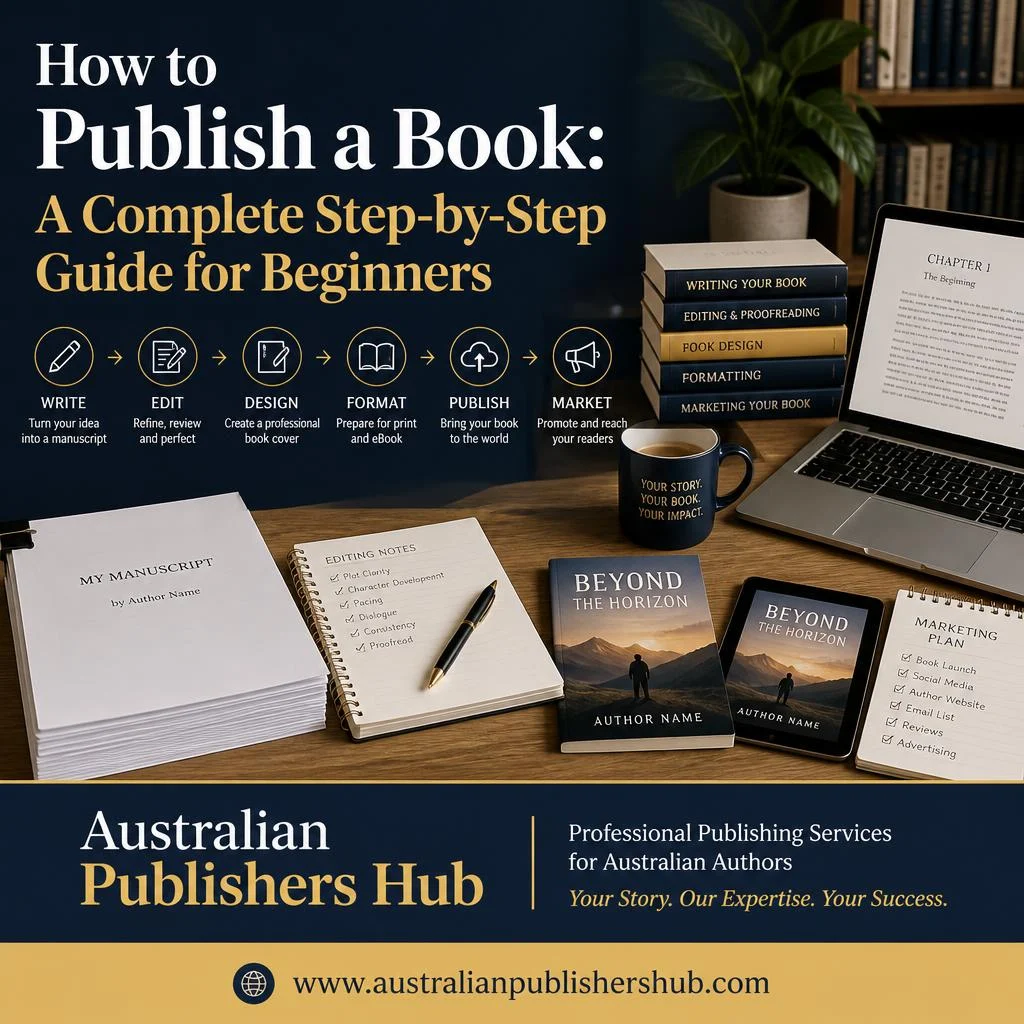
A typical self-publishing workflow looks like this:
Manuscript → Editing → Cover Design → Formatting → Publishing Setup → Distribution → Marketing
You can complete some parts yourself and outsource others.
Why Do Authors Choose Self-Publishing?
There are several common reasons.
Greater Control
The author decides:
Cover
Pricing
Release date
Book description
Formats
Marketing strategy
Faster Publishing Timeline
Traditional publishing can involve a lengthy submission and production process.
Self-publishing gives the author more control over scheduling.
However, rushing a book simply because it is possible to publish quickly can hurt quality.
Access to Niche Markets
Some books serve small but clearly defined audiences.
A highly specialised nonfiction book, local-interest publication or niche genre may work well through direct-to-reader publishing.
Direct Business Ownership
Self-published authors generally have greater control over their publishing accounts, sales information and product decisions, depending on the platforms and services they use.
What Does Self-Publishing Cost?
There is no universal self-publishing price.
Your costs depend on your book and the professional services you require.
Possible expenses include:
Editing
Proofreading
Cover design
Typesetting
Ebook formatting
ISBN requirements
Printing
Distribution
Marketing
A text-only novel may cost significantly less to produce than an illustrated full-colour book.
Instead of asking only how much self-publishing costs, ask what level of professional quality your particular project requires.
Print-on-Demand vs Bulk Printing
Self-published authors also need to decide how physical books will be produced.
Print-on-Demand
Print-on-demand means books are produced as orders are placed.
Advantages can include:
Lower inventory requirements
No need for large storage space
Reduced risk of unsold stock
Bulk Printing
Bulk printing involves producing a larger quantity at once.
It may make sense if you need books for:
Events
Direct sales
Schools
Organisations
Speaking engagements
Retail supply
However, larger print runs require stronger inventory planning.
What Is Hybrid or Assisted Publishing?
Hybrid or assisted publishing provides professional support while asking the author to contribute towards publishing costs.
Services can vary significantly.
An assisted publishing company might provide:
Editing
Cover design
Typesetting
Ebook formatting
Printing support
Distribution setup
Marketing assistance
Before paying a publishing provider, review its agreement carefully.
Ask:
What exactly is included?
Who owns the final files?
Who controls publishing accounts?
What rights do I retain?
What does distribution include?
Are revisions included?
Are there ongoing fees?
What happens if I cancel?
Avoid judging a publishing service by promises alone.
Look at clear deliverables.
Other Ways Authors Can Publish Their Work
Traditional and self-publishing are not the only options.
Depending on your project, you may also consider:
Independent and Small Presses
Small presses often focus on particular genres, communities or specialist subjects.
They may be more open to direct submissions than larger publishers.
Digital-First Publishing
Some publishers focus primarily on ebooks and digital-first releases.
This model can suit genres with strong online readerships.
Crowdfunding
Authors can sometimes fund publication by building an audience before production.
Supporters may receive:
Early copies
Signed books
Special editions
Additional content
Crowdfunding works best when the author already has access to a relevant audience or can build strong interest around the project.
Serial and Online Publishing
Some writers build audiences by sharing work through online publishing platforms, newsletters or serial-fiction communities before producing a full book.
This approach may help authors test ideas and build readership.
How to Build an Author Platform Before Publication
You do not need thousands of followers to become a published author.
However, having a way to reach potential readers can help with long-term book marketing.
An author platform might include:
Website
Email newsletter
Social media
Blog
Podcast appearances
Speaking events
Professional expertise
Writing communities
Nonfiction authors can particularly benefit from demonstrating expertise in the subject they write about.
For fiction authors, the manuscript itself remains central, but building a readership can still support future promotion.
Common Mistakes Writers Make When Trying to Get Published
Avoid these common mistakes.
Submitting Too Early
Your first draft is rarely ready for publishers.
Revise first.
Approaching the Wrong Publishers
Research what they actually publish.
Ignoring Submission Guidelines
Follow the requested format carefully.
Sending the Same Generic Query Everywhere
Tailor your approach where appropriate.
Paying for Services Without Understanding Them
Know exactly what is included in a publishing package.
Expecting Publication Alone to Create Sales
Publishing makes the book available. Marketing helps readers discover it.
Ignoring Book Design
Readers make quick visual judgements.
Professional presentation matters.
Signing Contracts Without Understanding Rights
A publishing deal involves intellectual-property rights. Read it carefully.
How Long Does It Take to Get a Book Published?
There is no fixed timeline.
Traditional publishing can take longer because several stages are involved:
Finding an agent
Submission to publishers
Contract negotiations
Editing
Production
Printing
Distribution
Release scheduling
Self-publishing can be faster because the author controls the schedule.
However, professional editing, formatting and production still require sufficient time.
A fast publication is not automatically a successful publication.
How to Choose the Best Publishing Route for Your Book
Ask yourself five questions.
1. How Much Creative Control Do I Want?
If maintaining control over design, pricing and schedule matters strongly to you, self-publishing may be attractive.
2. Am I Comfortable Waiting?
Traditional publishing can require patience.
3. Am I Prepared to Pay for Production?
Self-published authors normally finance professional production themselves.
4. Do I Want to Manage the Process?
Independent publishing requires project management.
5. What Does Success Mean to Me?
Success might mean:
Seeing your book in shops
Reaching a niche readership
Building authority
Earning income
Sharing a personal story
Creating a professional publication
Your definition of success should influence your publishing route.
A Simple Book Publishing Checklist
Before trying to publish your book, make sure you have covered the essentials.
Manuscript
Complete manuscript
Author revision
Editing
Proofreading
Research
Genre identified
Audience identified
Comparable books researched
Publishers or platforms researched
Traditional Publishing
Query letter
Synopsis
Sample chapters
Submission list
Agent research
Self-Publishing
Cover design
Interior formatting
Ebook files
Print setup
Distribution strategy
Pricing
Marketing plan
Final Checks
Publishing agreement reviewed
Book description prepared
Author biography prepared
Metadata checked
Launch plan prepared
Is It Better to Get a Publisher or Publish Yourself?
Neither option is automatically better.
Traditional publishing may be a better choice if you want:
Publisher investment
Professional infrastructure
Established distribution
Editorial support
Industry connections
Self-publishing may suit you if you want:
More control
Faster decision-making
Direct involvement
Flexible publishing schedule
Responsibility for your own publishing business
Assisted publishing may suit authors who want professional help without handing over the entire process.
Ready to Take Your Manuscript to Publication?
Learning how to get a book published becomes much easier when you break the process into clear stages.
Start by finishing and refining your manuscript. Then decide whether traditional publishing, self-publishing or an assisted route matches your goals.
If you choose traditional publishing, research the right agents and publishers and prepare a professional submission package.
If you choose self-publishing, invest your effort in the areas readers notice most: editing, design, formatting, distribution and presentation.
Authors who prefer professional support rather than coordinating every stage independently can explore Australian Publishers Hub for assistance with manuscript preparation and book publishing services.
The most important thing is not simply getting your book published.
It is publishing your book in a way that gives it the strongest possible chance of reaching the readers it was written for.
Frequently Asked Questions
What is the easiest way to get a book published?
Self-publishing usually offers the most direct route because you do not need approval from a traditional publisher. However, producing a professional-quality book still requires editing, design, formatting and distribution planning.
How do I get a publisher interested in my book?
Prepare a strong manuscript, understand your genre, research appropriate publishers and follow their submission guidelines carefully. A concise query letter and professional submission package can also help.
Do I need an agent to publish a book?
No. Some publishers accept direct submissions, and self-published authors do not need literary agents. However, an agent can be valuable when pursuing certain traditional publishers.
Should I finish my book before contacting a publisher?
New fiction authors are usually expected to have a completed manuscript. Nonfiction proposals may sometimes be considered before the entire book is finished, depending on the publisher.
How much does it cost to get a book published?
Traditional publishing generally does not require the author to pay normal production costs. Self-publishing costs depend on editing, design, formatting, printing, distribution and marketing requirements.
Can a first-time author get traditionally published?
Yes. Publishers regularly acquire debut authors, but traditional publishing is selective. A strong manuscript, careful research and professional submission can improve your chances.
Can I publish a book without a publishing company?
Yes. Self-publishing allows authors to publish independently using professional contractors and publishing platforms.
Ready to Publish Your Book?
Learn how to get a book published with this practical guide to traditional publishing, self-publishing, literary agents, editing and book submission.