Finishing a manuscript is a major achievement. The next challenge is knowing who to send it to, what publishers expect, and how to make your submission stand out.
If you are searching how to get a publisher for a book, the process starts with preparing your manuscript professionally, identifying publishers that actually publish your type of book, checking their submission requirements, and approaching them with a clear pitch and polished submission package.
For Australian writers, the process can be more accessible than many first-time authors expect because some publishers accept unsolicited manuscripts without requiring literary-agent representation.
This guide explains how to find a book publisher, prepare your manuscript, submit professionally, avoid common mistakes, compare publishing options, and decide what to do if traditional publishing is not the right route.
How to Get a Publisher for a Book: 7 Essential Steps
The basic publishing process can be broken into seven steps:
Complete and carefully revise your manuscript.
Identify your book's genre, audience and market position.
Research publishers that already publish comparable books.
Check whether they accept unsolicited manuscripts.
Prepare your synopsis, pitch and requested manuscript material.
Follow each publisher's submission instructions exactly.
Track submissions and continue approaching suitable publishers.
The most important factor is fit.
A strong manuscript sent to a publisher that does not handle your genre is unlikely to progress.
The Australian Society of Authors recommends researching both submission guidelines and the types of books already being published before approaching a publisher.
Understand Your Book Publishing Options in Australia
Before researching book publishers Australia, decide which publishing route best fits your goals.
Authors generally have three main options.
Traditional Book Publishing
In traditional publishing, a publishing company chooses manuscripts it wants to acquire and publish.
The publisher may manage:
Editing
Cover design
Interior design
Production
Printing
Distribution
Sales
Marketing support
Traditional publishers are selective because they invest resources into the books they acquire.
That means acceptance can be competitive.
Self-Publishing
Self-publishing gives authors greater control over the publishing process.
However, the author also becomes responsible for arranging:
Editing
Proofreading
Formatting
Cover design
Ebook preparation
Printing
Distribution
Marketing
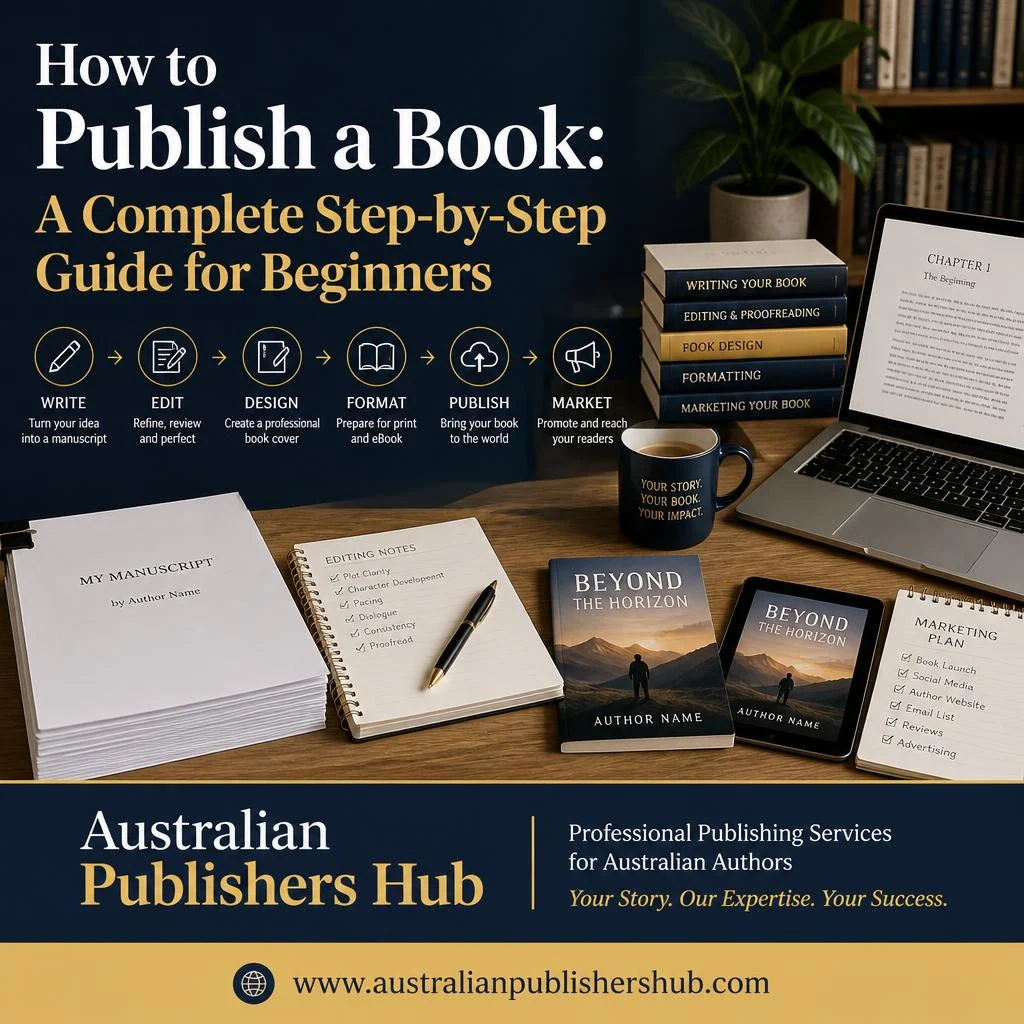
If you are considering this route, read Australian Publishers Hub's guide on how to publish a book in Australia for a broader overview of the publishing process.
Professional Book Publishing Services
Some authors want more control than traditional publishing provides but do not want to manage every production stage alone.
That is where professional book publishing services can help.
Australian Publishers Hub provides book publishing services covering areas such as manuscript preparation, editing, formatting, cover design, print preparation and release support.
Understanding the difference between a traditional publisher and a paid publishing-services provider is important when comparing book publishing companies Australia.
Step 1 — Prepare Your Manuscript Before Approaching Publishers
One of the biggest mistakes when publishing a book for the first time is submitting too early.
Completing a draft does not automatically mean the manuscript is ready for publishers.
Before submission, review:
Structure
Plot development
Chapter organisation
Character consistency
Pacing
Grammar
Spelling
Punctuation
Repetition
Tone
Readability
Genre expectations
The Australian Society of Authors recommends making a manuscript as polished as possible before approaching publishers because the submission creates the publisher's first impression of your work.
If your manuscript still needs refinement, professional book editing and proofreading services can help improve clarity, consistency, grammar, structure and presentation before submission.
Should You Get a Manuscript Assessment First?
A manuscript assessment can be useful if you are unsure whether the book is ready.
It is different from proofreading.
Proofreading focuses on final language-level errors.
A manuscript assessment usually looks at broader issues such as:
Structure
Story development
Characterisation
Pacing
Reader appeal
Strengths and weaknesses
Market positioning
Readiness for the next stage
The Australian Society of Authors' Manuscript Assessment Service explains that assessment can be particularly helpful for completed manuscripts that are approaching the final stages of development.
For first-time authors, the main question is simple:
Is the manuscript strong enough to approach publishers yet?
An independent assessment can help answer that before you begin submitting.
Step 2 — Understand What Kind of Book You Have Written
Before learning how to find a book publisher, you need to clearly understand your own manuscript.
Ask yourself:
Is it fiction or non-fiction?
What is the exact genre?
Who is the intended reader?
What age group is it written for?
What makes the book different?
What similar books are already published?
Why would readers choose your book?
For example, saying:
“I wrote a book about university life.”
is too broad.
A stronger description would be:
“A contemporary coming-of-age novel about an international student adjusting to university life in Melbourne while balancing family expectations, academic pressure and independence.”
The second version immediately communicates genre, setting, audience and central conflict.
That makes it much easier for a publisher to understand where your manuscript fits.
Step 3 — Research Australian Book Publishers in Your Genre
Effective finding a publisher for a book should be targeted.
Do not simply collect hundreds of publisher email addresses.
Instead, identify Australian book publishers that already publish books similar to yours.
Research:
Genres they publish
Recent releases
Target audiences
Submission windows
Whether submissions are currently open
Whether unsolicited manuscripts are accepted
Whether an agent is required
Requested submission materials
The Australian Society of Authors Book Industry Directory can also help writers research publishers, literary agents and other parts of the Australian publishing industry.
How to Find a Book Publisher That Fits Your Genre
Start with books that are similar to yours.
Suppose you have written young-adult fantasy.
Look at successful Australian YA fantasy titles and ask:
Who published them?
Does that publisher still publish the genre?
Does its current list resemble your book?
Is it accepting submissions?
Does it accept direct submissions?
This approach is much more effective than mass-emailing publishers.
Ten highly relevant publishers can be more valuable than 100 unrelated ones.
Step 4 — Decide Whether You Need a Literary Agent
A literary agent represents authors when dealing with publishers.
Agents may help with:
Finding suitable publishers
Improving pitches
Submitting manuscripts
Negotiating contracts
Managing rights
Exploring international publishing opportunities
Do you need an agent in Australia?
Not always.
Some Australian publishers accept unsolicited submissions directly from authors.
However, an agent may still be useful if you want professional representation, help negotiating contracts or access to publishers that prefer agented submissions.
Before approaching either an agent or publisher, check their current submission policies carefully.
Step 5 — Learn How to Submit a Manuscript to a Publisher
If you want to know how to submit a manuscript to a publisher, remember one rule above everything else:
Follow the publisher's instructions exactly.
Publishers may request different materials.
Common requirements include:
Query or cover letter
Short book pitch
Synopsis
Sample chapters
Complete manuscript
Author biography
Word count
Target audience
Comparable titles
Contact information
If a publisher asks for three chapters, do not automatically send the entire manuscript.
If it requests a certain file type, use that format.
Submission guidelines are there for a reason.
Ignoring them can make your manuscript harder to assess and may create an unprofessional first impression.
Step 6 — Create a Strong Book Pitch
A book pitch should explain the project quickly and clearly.
A strong pitch usually answers five questions.
What Is the Book?
State the genre, central premise and main hook.
Who Will Read It?
Define the target reader.
Why Is It Interesting?
Explain the feature that makes your manuscript distinctive.
Where Does It Fit?
Mention comparable titles where appropriate.
Why Are You the Right Author?
For non-fiction especially, mention qualifications or experience that are directly relevant to the subject.
The pitch should create enough interest for an editor to want to read more.
Do not overload it with unnecessary background information.
Step 7 — Write a Clear Synopsis
A synopsis explains the overall story or argument.
For fiction, that means revealing major events.
Yes, that normally includes the ending.
A synopsis is different from back-cover copy.
Back-cover copy creates curiosity.
A synopsis tells the publisher what actually happens.
For non-fiction, you may instead need a proposal explaining:
Central concept
Intended readership
Book structure
Chapter summaries
Comparable titles
Market positioning
Author credentials
Always follow the receiving publisher's requirements.
Track Your Book Publisher Submissions
Once you begin sending manuscripts, create a submission tracker.
Publisher | Genre Fit | Date Submitted | Materials Sent | Status |
Publisher A | Strong | 10 March | Synopsis + 3 chapters | Pending |
Publisher B | Strong | 18 March | Full manuscript | Under Review |
Publisher C | Moderate | 25 March | Proposal | Submitted |
A tracker helps you:
Avoid duplicate submissions
Monitor response times
Remember submission requirements
Organise follow-ups
Compare opportunities
Also check each publisher's rules regarding simultaneous submissions.
Do not assume every company has the same policy.
How Long Does It Take to Get a Publisher?
There is no fixed timeline.
Publishers receive many manuscripts and usually assess them through multiple stages.
Response times can depend on:
Submission volume
Editorial workload
Publishing schedules
Genre priorities
Market demand
Internal acquisition processes
A long response time does not necessarily mean the manuscript has been rejected.
Follow the timeframe stated in the publisher's guidelines and avoid repeatedly contacting the editorial team unless the publisher invites follow-ups.
Common Mistakes When Finding a Publisher for a Book
Submitting to the Wrong Publisher
A strong romance novel is unlikely to succeed with a publisher that only handles academic textbooks.
Research genre fit first.
Ignoring Submission Guidelines
If a publisher asks for a synopsis and three chapters, submit exactly that.
Following instructions demonstrates professionalism.
Sending an Unedited Manuscript
Spelling mistakes, inconsistent names, awkward sentences and formatting issues can distract from the quality of the manuscript.
If necessary, consider professional book editing and proofreading before submission.
Using the Same Generic Pitch Everywhere
Your core book description can remain consistent, but your submission should reflect why the book fits that particular publisher.
Paying Without Understanding the Publishing Model
Before paying a company, establish whether it is:
A traditional publisher
A self-publishing platform
A professional author-services provider
A printing business
A hybrid publishing arrangement
Understand exactly what you are paying for and read contractual terms carefully.
Traditional Publishing vs Professional Book Publishing Services
These two publishing routes are often confused.
Traditional Publishing | Professional Publishing Services |
Publisher chooses manuscripts | Author chooses services |
Acceptance is competitive | Services depend on project requirements |
Publisher controls many production decisions | Author usually retains more involvement |
Publishing agreement determines rights | Author purchases defined services |
Publisher manages its own distribution model | Distribution support depends on provider |
Neither route is automatically right for everyone.
Ask yourself:
Do I want traditional acquisition?
How much creative control do I want?
How quickly do I want to publish?
Am I comfortable managing production?
Do I need professional editing or design support?
If independent publishing better suits your goals, Australian Publishers Hub offers professional book publishing services across editing, formatting, cover design, print preparation and release support.
How to Publish a Book in Australia Without a Traditional Publisher
Traditional publishing is not the only route available.
If you decide to publish independently, a professional process may include:
Manuscript assessment
Structural editing
Copyediting
Proofreading
Cover design
Interior formatting
Ebook preparation
Print preparation
Distribution planning
Book marketing
For a broader breakdown, read Australian Publishers Hub's guide on how to publish a book in Australia.
Authors who are ready for physical production can also explore book printing services in Australia.
Publishers for First-Time Authors: What Should New Writers Know?
Being a first-time author does not automatically prevent you from getting published.
When researching publishers for first-time authors, focus on:
Manuscript quality
Clear genre
Defined audience
Professional presentation
Strong submission materials
Publisher fit
Patience
For university and college students, academic knowledge may sometimes strengthen a non-fiction proposal.
For example, an environmental-science student writing an accessible book about climate systems may be able to mention relevant academic knowledge.
However, qualifications alone do not replace:
Strong writing
Clear structure
Audience demand
Publisher fit
The manuscript still has to work as a book.
Book Publisher Submission Checklist
Before sending anything, check the following.
Manuscript
Is the manuscript complete?
Has it been thoroughly revised?
Have grammar and spelling been checked?
Is formatting consistent?
Do you know the word count?
Positioning
Is the genre clear?
Is the intended reader clear?
Can you explain the book in one sentence?
Have you researched comparable titles?
Publisher Research
Does the publisher handle your genre?
Are submissions open?
Does it accept unsolicited manuscripts?
Have you read all submission instructions?
Submission Package
Is the query letter ready?
Is the synopsis ready?
Have you included only the requested material?
Is the author bio concise?
Are all files professionally named?
Have you proofread the submission email?
If several answers are “no,” improve your submission before sending it.
How Australian Publishers Hub Can Help Prepare Your Book
Not every manuscript needs the same service.
One author may only need proofreading.
Another may require structural editing, formatting, cover design and print preparation.
Australian Publishers Hub provides professional book publishing services for fiction, non-fiction, memoir, children's books and other publishing projects.
Authors who primarily need manuscript refinement can use book editing and proofreading services.
For authors ready to produce physical copies, book printing services can support paperback, hardcover and print-on-demand production.
The key is to choose the services your book actually needs instead of paying for unnecessary extras.
Final Thoughts on How to Get a Publisher for a Book
Learning how to get a publisher for a book is not about sending the same manuscript to as many publishing companies as possible.
It is about preparation, research and fit.
Start by making the manuscript as strong as possible.
Then:
Define the genre and target reader.
Research suitable Australian book publishers.
Check current submission requirements.
Prepare a professional pitch and synopsis.
Follow every instruction.
Track submissions carefully.
Consider traditional, agented and independent publishing routes.
If your manuscript still needs editorial or production work before publication, Australian Publishers Hub's book publishing services can help with preparation, editing, design, formatting and print readiness.
Frequently Asked Questions
How much does it cost to get a publisher for a book?
With traditional publishing, authors generally do not pay a publisher simply to accept and publish their manuscript. The publisher normally manages production costs according to the publishing agreement.
Costs are different with self-publishing or professional publishing services. Authors may pay for editing, proofreading, cover design, formatting, printing, distribution support and marketing.
Always understand the publishing model and all contractual costs before paying a company.
How do first-time authors get published?
First-time authors usually get published by preparing a polished manuscript, identifying their genre and audience, researching suitable publishers or agents, and submitting according to each publisher's guidelines.
Some Australian publishers accept unsolicited manuscripts, allowing first-time authors to approach them directly when submissions are open.
Who is the best publisher for first-time authors?
There is no single best publisher for every first-time author.
The right publisher depends on:
Your genre
Target readership
Manuscript quality
Publishing goals
Current submission opportunities
Look for publishers that publish your genre, work with new authors, reach your intended audience and provide clear submission guidelines.
Publisher-manuscript fit matters more than choosing the biggest company.
How do I get a publisher for my first book?
Complete and revise the manuscript, identify its genre and readership, research publishers that handle similar books, check submission requirements, and send the requested pitch, synopsis and manuscript material professionally.
How do I find Australian book publishers?
Start with books similar to yours and identify who published them. Then review each publisher's current catalogue and submission policy.
Industry resources such as the Australian Society of Authors can also help you research publishers and literary agents.
Do I need a literary agent in Australia?
Not always.
Some Australian publishers accept unsolicited manuscripts directly from writers.
However, an agent can help with publisher targeting, submissions, contract negotiation and rights management.
Should I edit my book before submitting it?
Yes. Your manuscript should be as polished as possible before approaching publishers.
Professional assessment, editing or proofreading may help identify structural, grammatical and consistency issues before submission.
What should I send to a book publisher?
Requirements vary.
Common materials include:
Query letter
Synopsis
Sample chapters
Author biography
Word count
Comparable titles
Complete manuscript
Always follow the exact guidelines supplied by the publisher.
Can first-time authors get published?
Yes.
First-time authors can secure traditional publishing deals when their manuscript fits the publisher's list and meets editorial and commercial expectations.
Previous publishing experience can help, but it is not the only factor.
What can I do if traditional publishers reject my manuscript?
You can revise the manuscript, approach other relevant publishers, seek literary-agent representation, obtain a professional manuscript assessment or consider independent publishing.
If you choose the independent route, professional book publishing services can help with editing, formatting, cover design, printing and release preparation.
Ready to Publish Your Book?
Learn how to get a publisher for a book in Australia, find suitable publishers, prepare your manuscript and submit professionally.