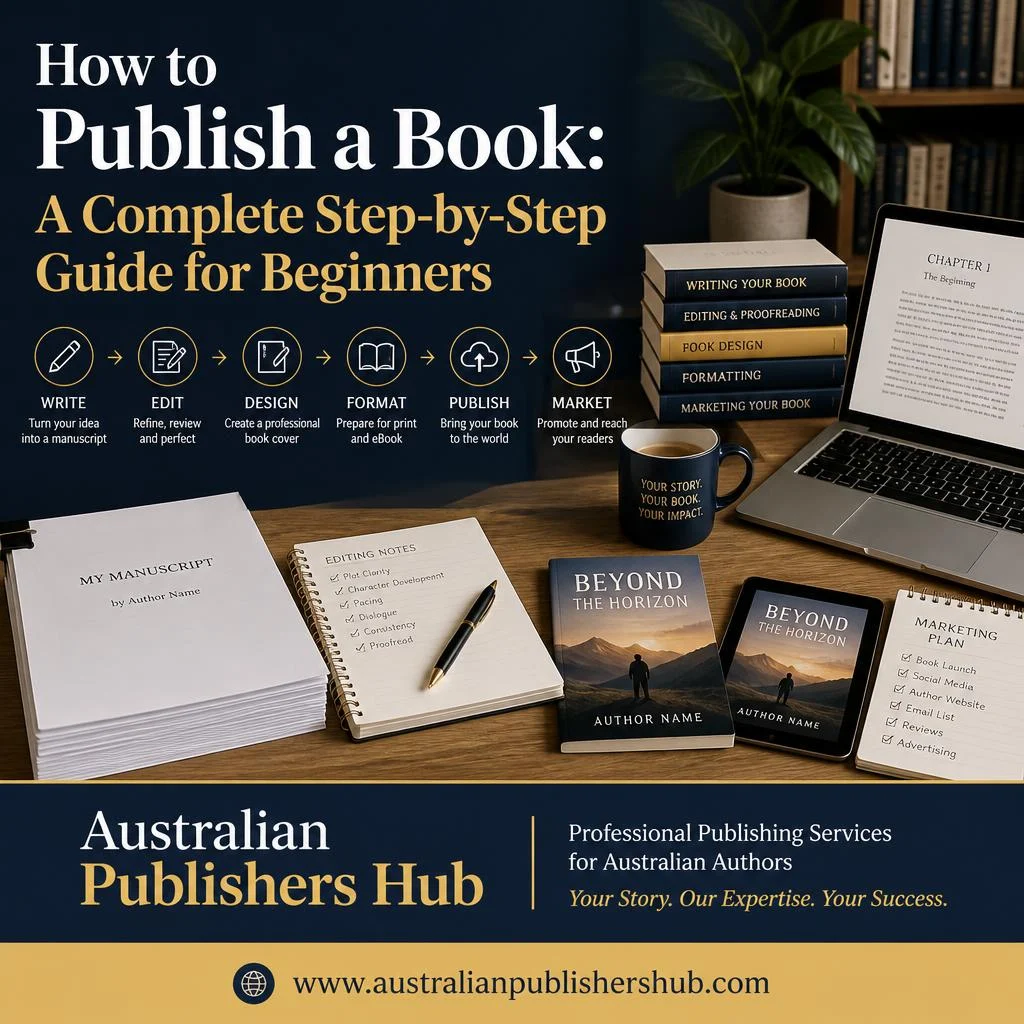
To publish a book professionally, you need to prepare your manuscript, decide between traditional and self-publishing, complete editing and proofreading, organise the cover and interior design, select appropriate publishing formats, understand important Australian publishing requirements, and plan how the book will reach readers.
This guide explains how to get a book published in Australia step by step. Whether you are a student, graduate, researcher, first-time novelist, memoir writer or aspiring non-fiction author, you will learn how the book publishing process works and what to consider before releasing your work.
How Can I Get a Book Published in Australia?
The simplest answer is that you need to transform your manuscript from a working draft into a professionally prepared publication.
The main steps usually include:
Complete and revise your manuscript.
Identify your genre and target audience.
Choose traditional publishing or self-publishing.
Arrange professional editing and proofreading.
Create the book cover and interior layout.
Select print, eBook or other formats.
Prepare book metadata and publishing information.
Check ISBN requirements.
Review copyright and permissions.
Check relevant Australian legal deposit requirements.
Select printing and distribution options.
Develop a launch and book marketing strategy.
The exact route depends on your goals. Some writers approach traditional book publishers in Australia, while others prefer self-publishing and arrange professional assistance with editing, design, production and release.
Authors who want coordinated support can explore professional book publishing services from Australian Publishers Hub, which cover manuscript assessment, editing, formatting, cover design, print preparation and release support.
Traditional Publishing vs Self-Publishing in Australia
One of the biggest decisions an author needs to make is how the book will be published.
Traditional publishing and self-publishing can both lead to professionally produced books, but they differ in creative control, responsibility, production arrangements and timelines.
Traditional Book Publishing
With traditional book publishing, an author generally submits a manuscript or proposal to an established publisher or literary agent.
If the publisher decides to acquire the book, it usually coordinates agreed elements of:
Editing
Proofreading
Cover design
Formatting
Printing
Distribution
Sales
Marketing
Traditional publishers are selective, and not every publisher accepts every genre or unsolicited manuscript.
Before submitting your work, investigate the publisher's current requirements. You may be asked to provide sample chapters, a complete manuscript, a synopsis, author biography, proposal, intended audience or information about comparable books.
The most important rule is simple: follow the individual publisher's submission guidelines rather than sending an identical package to every company.
Self Publishing a Book
With self publishing a book, the author manages the publishing project independently or hires specialists to complete individual stages.
Professional support might include:
Manuscript assessment
Developmental editing
Copyediting
Proofreading
Cover design
Interior formatting
eBook preparation
Illustration
Book printing
Distribution preparation
Author branding
Book marketing
Self-publishing usually gives authors greater control over their publishing schedule, files and creative decisions. However, it also places more responsibility on the author to make sure each stage is completed professionally.
Australian Publishers Hub provides book publishing support for Australian authors who want to coordinate several of these stages through one publishing workflow.
Traditional Publishing vs Self-Publishing
Publishing Factor | Traditional Publishing | Self-Publishing |
Manuscript acceptance | Publisher normally decides whether to acquire it | Author decides whether and when to publish |
Creative control | Shared with publisher | Usually greater author control |
Editing | Generally organised by publisher | Arranged by author or publishing service |
Cover design | Usually managed by publisher | Author generally has greater input |
Publishing schedule | Largely controlled by publisher | More flexible |
Production responsibility | Mainly publisher | Mainly author |
Distribution | Usually organised by publisher | Author chooses distribution options |
Best suited to | Authors seeking a conventional publishing arrangement | Authors wanting flexibility and greater control |
Neither route is automatically better. Your choice should depend on your goals, manuscript, preferred level of control, resources and expectations.
How Does the Book Publishing Process Work?
The book publishing process transforms an author's manuscript into a professionally produced book that readers can buy or access.
Although individual projects differ, most books pass through similar editorial, design, production and release stages.
1. Finish and Review Your Manuscript
Before thinking about printing or cover design, make sure your manuscript is genuinely ready to move forward.
A first draft is rarely a final manuscript.
Review the complete book for:
Overall structure
Chapter order
Repetition
Missing information
Tone and voice
Character consistency
Plot development
Pacing
Arguments and evidence
Reader experience
For fiction, focus on plot, character development, dialogue, pacing and continuity.
For non-fiction, consider whether every chapter has a clear purpose and whether ideas develop logically.
Students and graduates adapting academic research into a book should also think carefully about audience. A thesis, dissertation or university assignment is written for an academic context; a book aimed at general readers may require a different structure, tone and level of explanation.
2. Identify Your Target Readers
Before asking how to publish a book, ask another important question:
Who will actually read it?
Trying to write for “everyone” can make editing, positioning and marketing more difficult.
Define your target audience by considering:
Age group
Interests
Knowledge level
Problems or interests addressed by the book
Genre
Reading preferences
Location
Preferred book format
For example, a career guide based on university experience may primarily target final-year students and recent graduates rather than every adult reader.
Your audience influences your cover, language, editing style, categories, description and marketing strategy.
3. Choose the Right Publishing Route
Once your manuscript is developed, decide whether you want to approach traditional publishers or independently manage publication.
If you are researching book publishers Australia, focus on companies that work with your particular genre.
Before approaching a publisher, check:
Genres accepted
Submission periods
Manuscript requirements
Whether unsolicited submissions are accepted
Required proposal materials
Preferred file format
Current submission policies
If you choose self-publishing, create a production plan covering editing, design, formatting, publishing, printing, distribution and marketing.
4. Get Your Manuscript Professionally Edited
Professional editing is an important stage when publishing a book for the first time.
Because authors know their own work so well, they can easily overlook structural problems, repeated ideas, unclear sentences and inconsistencies.
Australian Publishers Hub's professional book editing services include structural editing, line editing, copyediting, proofreading and consistency checks depending on the needs of the manuscript.
Developmental or Structural Editing
Structural editing looks at the manuscript as a whole.
For fiction, it may assess:
Plot structure
Character development
Pacing
Narrative flow
Scene effectiveness
Continuity
For non-fiction, it may examine:
Chapter organisation
Argument structure
Information gaps
Repetition
Logical progression
Reader clarity
Copyediting
Copyediting focuses more closely on the language.
It can address:
Grammar
Sentence structure
Punctuation
Word choice
Terminology
Consistency
Clarity
Style
The goal is to improve the writing without unnecessarily replacing the author's natural voice.
Proofreading
Proofreading is normally one of the final editorial checks.
It looks for remaining problems such as:
Typographical errors
Misspellings
Punctuation mistakes
Repeated or missing words
Heading inconsistencies
Spacing problems
Formatting errors
Editing and proofreading are related, but they are not interchangeable. A manuscript with significant structural problems should not rely on proofreading alone.
5. Create a Professional Book Cover
Your book cover is one of the first things a potential reader will notice.
A professional print cover may include:
Front cover
Spine
Back cover
Title
Subtitle
Author name
Book description
Typography
Imagery or illustration
Relevant publication details
The design should reflect your genre and target audience.
A thriller, children's book, memoir, business title and academic non-fiction book should not all look the same.
Australian authors who need design assistance can explore professional book cover design services for print and digital publishing projects.
6. Format the Interior of the Book
The interior needs the same professional attention as the cover.
Book formatting can involve:
Trim size
Margins
Paragraph indentation
Line spacing
Typeface
Font size
Chapter headings
Headers and footers
Page numbering
Contents pages
Image placement
Section breaks
Print books and eBooks also have different technical requirements.
A printed book generally uses a fixed page layout, while many eBooks use responsive text that adjusts to the device and reader settings.
7. Decide Which Book Formats to Publish
Your book could be released as:
Paperback
Hardcover
eBook
Audiobook
A combination of formats
You do not need to produce every version immediately.
Choose formats according to your readership, budget, content and distribution strategy.
For example, a highly visual children's title may benefit strongly from print, whereas a practical guide aimed at university students may work effectively as both paperback and eBook.
8. Prepare Your Book Metadata
Metadata describes and identifies your publication.
It can include:
Title
Subtitle
Author name
Contributor information
Book description
Genre
Categories
Keywords
Publication date
Language
Edition
Format
ISBN
Accurate metadata helps retailers, distributors, libraries and readers understand what your book is and who it is for.
Keep this information consistent wherever the book appears.
9. Understand ISBN Requirements in Australia
An ISBN, or International Standard Book Number, is a unique identifier used in the book trade and library sector.
The National Library of Australia explains that an ISBN is not legally mandatory and does not create copyright protection, but it is widely used internationally to identify books. Australian publishers can obtain ISBNs through the Australian ISBN Agency operated by Thorpe-Bowker.
For authoritative guidance, see the National Library of Australia's ISBN information.
Thorpe-Bowker also explains that individual book formats or editions may require their own identifiers.
Before purchasing ISBNs, determine which editions and formats you actually intend to publish.
10. Check Copyright and Permissions
Understanding copyright is another important part of learning how to get a book published in Australia.
Copyright protection in Australia is generally automatic and free; there is no formal Australian copyright-registration system required simply to obtain protection for qualifying original work.
Authors can read the Australian Government's copyright guidance for current official information.
You should also review any content in your manuscript that someone else created, including:
Photographs
Illustrations
Maps
Charts
Tables
Quotations
Song lyrics
Previously published material
Using something found online does not automatically give you permission to reproduce it in a commercial book. Australian Government guidance states that copyrighted material can generally be used where permission has been obtained or a relevant copyright exception or statutory licence applies.
Students and researchers adapting previous academic work should also check any collaboration, confidentiality, research or institutional obligations that may affect publication.
11. Understand Australian Legal Deposit Requirements
Australian authors and publishers should also check legal deposit requirements before or around publication.
The National Library of Australia states that publications covered by federal legal deposit requirements should generally be deposited within one month of publication. Its guidance also explains that electronic publications can be deposited through the National edeposit service, and authors or publishers may still have separate state or territory obligations.
Read the National Library of Australia's legal deposit guidance before releasing your book.
Because requirements can depend on publication format and jurisdiction, check the current rules when your publication is ready rather than relying on old publishing advice.
12. Choose Between Print-on-Demand and Bulk Printing
Printing decisions can have a significant impact on production costs and inventory.
Print-on-Demand
Print-on-demand allows copies to be produced as they are needed.
This may help reduce:
Large upfront inventories
Storage requirements
Unsold stock
It can be a practical option for authors who do not yet know how many physical copies they will need.
Bulk Book Printing
Larger print runs may make sense when an author already has reliable demand or needs stock for:
Events
Direct sales
Organisations
Educational use
Retail distribution
Before ordering a large quantity, consider printing costs alongside storage, delivery, fulfilment and realistic demand.
Australian Publishers Hub provides book printing services across Australia including paperback, hardcover, custom-size, colour and print-on-demand options.
13. Choose Your Book Distribution Channels
Publishing does not automatically mean readers will know where to find your book.
Possible sales and distribution channels include:
Online retailers
Author websites
Bookshops
Wholesalers
Libraries
Events
Educational organisations
Specialist retailers
The most appropriate combination depends on your genre and audience.
A specialist professional handbook may require a different distribution strategy from a children's picture book or commercial novel.
14. Start Marketing Before Publication
Book marketing should begin before the release date rather than after the book has already launched.
Prepare resources such as:
Author website
Book landing page
Email list
Author biography
Professional photographs
Book description
Promotional graphics
Social content
Reviewer outreach
Interviews
Launch events
Your marketing should explain why the book matters to its intended reader instead of repeatedly telling people to buy it.
For more guidance, Australian Publishers Hub provides book marketing services and has also published guidance on ways to promote a new book online.
Common Mistakes When Publishing a Book for the First Time
First-time authors should avoid:
Publishing an unrevised first draft
Skipping professional editing
Treating proofreading as a substitute for editing
Designing the cover before the manuscript is stable
Choosing publishers without researching them
Signing agreements without understanding the terms
Ordering excessive printed stock
Ignoring copyright permissions
Using low-resolution images
Publishing without defining the audience
Creating inconsistent metadata
Waiting until launch day to start marketing
A clear publishing plan can prevent many of these problems.
What Professional Book Publishing Services Might You Need?
Not every book requires the same level of assistance.
Depending on the manuscript, professional book publishing services may include:
Manuscript assessment
Developmental editing
Copyediting
Proofreading
Cover design
Interior formatting
Illustration
eBook preparation
Print preparation
Publishing support
Distribution guidance
Author branding
Book marketing
The important question is not, “Which is the biggest publishing package?”
It is:
“What does my manuscript genuinely need before it is ready for readers?”
Australian Publishers Hub offers professional book publishing services for Australian authors that can be selected individually or combined according to the stage of the manuscript.
How to Become a Published Author: A Practical Checklist
If your goal is to understand how to become a published author, use this checklist:
Complete your manuscript.
Identify the genre and target reader.
Revise the complete draft.
Choose traditional publishing or self-publishing.
Arrange professional editing.
Complete proofreading.
Design the cover.
Format the interior.
Select print and digital formats.
Prepare metadata.
Confirm ISBN requirements.
Review copyright and permissions.
Check Australian legal deposit requirements.
Select printing options.
Choose distribution channels.
Prepare a marketing and launch plan.
Review all final files before publication.
Treat publishing as a sequence of manageable decisions rather than one enormous task.
How Long Does It Take to Publish a Book?
There is no universal publishing timeline.
The time required depends on factors such as:
Manuscript length
Condition of the draft
Level of editing needed
Author revisions
Cover complexity
Illustration requirements
Formatting
Printing
Publishing route
Approval time
Traditional publishing schedules are normally determined largely by the publisher.
Self-publishing gives an author greater control over the schedule, but rushing through editing, design or proofreading simply to release quickly can reduce the quality of the finished book.
How Much Does It Cost to Publish a Book in Australia?
There is no single standard cost for publishing a book in Australia.
Costs vary according to:
Word count
Manuscript condition
Editing requirements
Cover complexity
Illustration requirements
Book size
Interior design
Print format
Colour requirements
Number of copies
Marketing support
A text-only novel and a full-colour illustrated children's book naturally have very different production requirements.
When comparing providers, request an itemised scope so you understand exactly what is included rather than comparing headline prices alone.
Need Help Publishing Your Book in Australia?
If you are still asking, “How can I get a book published?”, begin by identifying the stage your manuscript has reached.
A recently completed manuscript may need assessment and editing. An edited manuscript may be ready for cover design and formatting. A production-ready title may need printing, release or marketing support.
Australian Publishers Hub works with Australian authors at different stages of the publishing journey through book publishing services, book editing and proofreading, professional cover design, book printing and book marketing.
Whether you are publishing a book for the first time or preparing your next title, a structured approach can help you move from manuscript to finished publication with greater clarity and fewer avoidable problems.
Frequently Asked Questions
How do I get my first book published in Australia?
Complete and revise your manuscript, decide between traditional publishing and self-publishing, arrange the necessary editing and design, prepare your publication files, confirm relevant Australian requirements and select suitable distribution channels.
How do I find book publishers in Australia?
Research publishers that actively work with your genre and check their latest submission guidelines. Review the books they already publish before sending your manuscript or proposal.
Can I publish my own book in Australia?
Yes. Authors can self-publish in Australia and either manage the process themselves or work with professional editors, designers, printers and publishing specialists.
Do I need a traditional publisher to publish a book?
No. Traditional publishing is one option, while self-publishing allows authors to manage their own publication. The most appropriate route depends on your goals, resources and preferred level of control.
Do I need an ISBN to publish a book in Australia?
An ISBN is not legally mandatory in Australia, according to the National Library of Australia, but it is widely used by the international book trade and library sector to identify books. Check the requirements of your chosen retailers and distributors before publication.
How much does it cost to publish a book in Australia?
There is no fixed price. Costs depend on manuscript length, editing, cover design, illustrations, formatting, book format, printing quantity and marketing requirements.
Is self-publishing suitable for a first-time author?
It can be. Self-publishing offers greater control over publishing decisions and timing, but the author also needs to coordinate professional editing, design, production, distribution and marketing.
Ready to Publish Your Book?
Learn how to get a book published in Australia, from editing and design to self-publishing, ISBNs, printing, distribution and book marketing.