Getting a book published can feel overwhelming, especially if you are a first-time author or a university student hoping to turn your research, creative writing, or original ideas into a published work. The good news is that understanding how to get a publisher for a book becomes much easier when you know which publishing route to choose, how to prepare your manuscript, and where to submit your work.
In Australia, authors can approach traditional publishers, work with literary agents, or explore self-publishing. Each option has different requirements, costs, and benefits. This guide explains how to find a book publisher, prepare a professional submission, understand publishing contracts, and avoid common mistakes. You will also discover useful Australian publishing resources and practical ways to prepare your manuscript for consideration.
How to Get a Publisher for a Book: A Quick Overview
To get a publisher for a book, prepare a polished manuscript, identify publishers that specialise in your genre, review their submission guidelines, and send the requested materials. Some publishers accept manuscripts directly, while others require authors to work through literary agents.
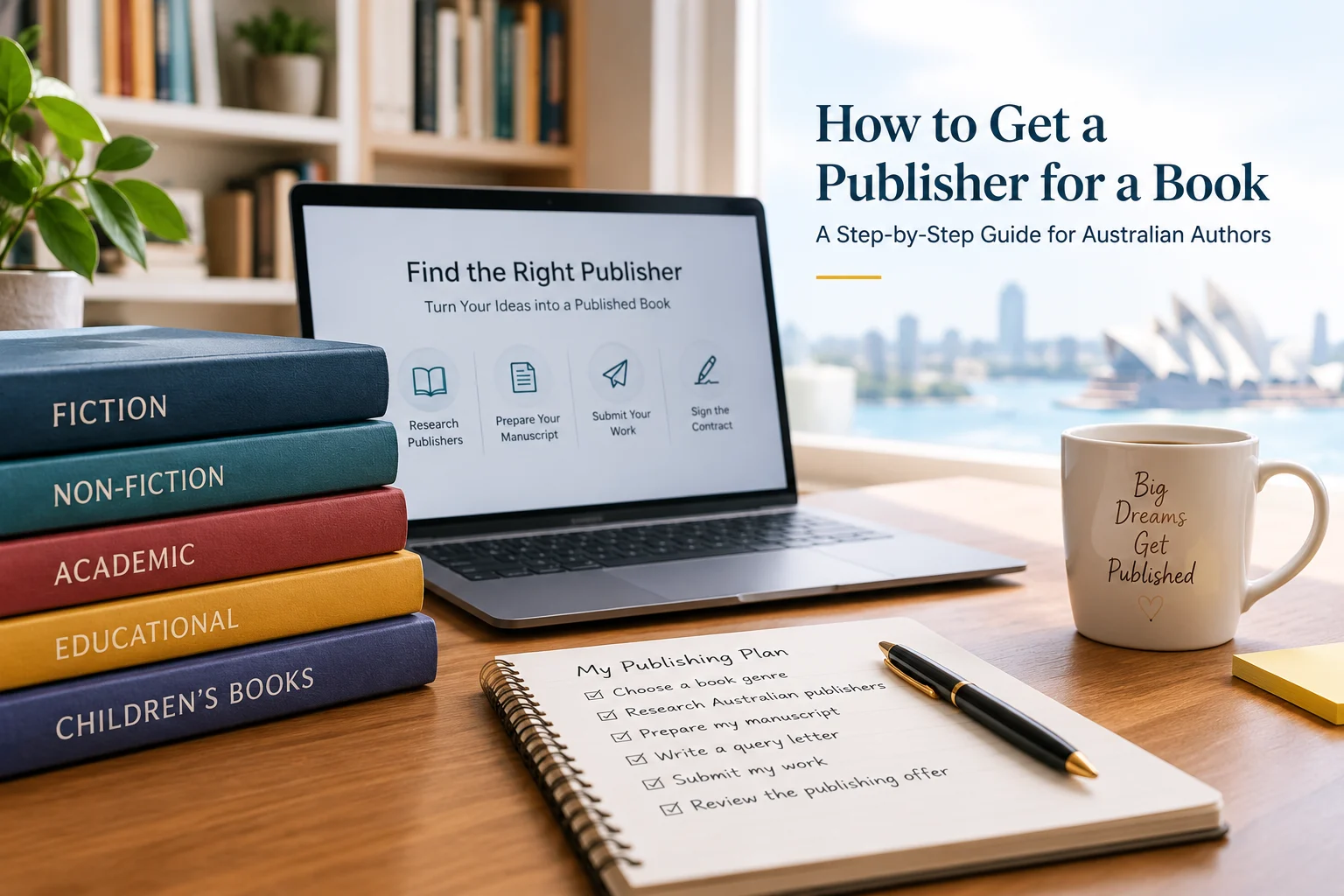
Follow these six steps:
Decide what type of book you want to publish.
Research suitable Australian book publishing companies.
Edit and prepare your manuscript or book proposal.
Write a professional query letter.
Submit your work according to the publisher's guidelines.
Review any publishing offer carefully before signing a contract.
For further guidance, read our related article on how to publish a book in Australia.
1. Decide What Type of Book You Want to Publish
Before searching for publishers, identify your book's genre, subject, and intended audience. Publishers usually specialise in particular categories, so choosing the right target will make your search more effective.
Common book categories include:
Fiction: Novels, short stories, romance, fantasy, crime, and literary fiction.
Non-fiction: Biographies, memoirs, business books, self-help, and history.
Academic books: Research-based publications, textbooks, and scholarly monographs.
Educational books: Study guides, instructional resources, and subject-specific learning materials.
Children's books: Picture books, early readers, and books for young adults.
If you are a university student, you might want to transform a dissertation, research project, or collection of essays into a book. However, academic work often requires substantial revision before it is suitable for a commercial audience.
Ask yourself:
Who is most likely to read this book?
What makes it different from existing titles?
Why would a publisher consider investing in it?
Your answers will help you identify relevant publishers and explain your book's value in a proposal.
2. How to Find a Book Publisher in Australia
The best way to find a publisher for your book is to research companies that already publish work similar to yours. Rather than contacting every publisher you discover, create a shortlist based on genre, audience, and submission requirements.
Research Australian book publishing companies
Start by reviewing books in your genre. Check their copyright pages to identify the publishers behind them, then explore those publishers' catalogues and official websites.
You can research publishers such as:
Allen & Unwin
Melbourne University Publishing
University of Queensland Press
Pan Macmillan Australia
Text Publishing
These publishers cover different areas of the market, and their submission policies may change. Check their official websites to confirm whether they currently accept your type of manuscript.
You can also explore the Australian Publishers Association for information about the publishing industry and publisher resources.
Check publishers accepting submissions
Not every publishing company accepts unsolicited manuscripts. Some review submissions directly from authors, while others require representation by a literary agent.
Before submitting your work, check:
Whether unsolicited manuscripts are accepted.
Whether the publisher requires a literary agent.
Which genres and subjects it considers.
Whether submissions are currently open.
What documents and formatting are required.
Whether simultaneous submissions are permitted.
For example, if you are writing a historical novel, a publisher with a strong fiction catalogue may be a better choice than a company specialising exclusively in academic textbooks.
For a practical starting point, review Allen & Unwin's submission guidelines and follow the current instructions relevant to your manuscript.
3. Prepare Your Manuscript Before Approaching Publishers
A strong manuscript demonstrates that you have developed your idea, considered your readers, and taken the writing process seriously.
For fiction, complete and revise the manuscript unless a publisher specifically requests a partial submission or proposal. For non-fiction and academic books, some publishers accept proposals before the entire manuscript is finished.
Edit and proofread your work
Before submitting, review your manuscript for:
Grammar, spelling, and punctuation.
Clear structure and logical progression.
Consistent tone and writing style.
Repetition and unnecessary material.
Unsupported claims and source accuracy.
Permissions for quotations, images, or other third-party material where necessary.
Professional book editing and proofreading can help improve clarity, consistency, and readability before submission.
Prepare a book proposal
A book proposal explains what your book is about, who will read it, and why it may suit the publisher's list.
Depending on the publisher's requirements, your proposal may include:
Book overview: A summary of the central idea, argument, or story.
Target audience: The readers most likely to benefit from the book.
Comparable titles: Similar books and how yours differs.
Author biography: Relevant experience, qualifications, or subject knowledge.
Chapter outline: A summary of the planned contents.
Sample chapters: Examples of your writing.
Project status: Whether the manuscript is complete and your expected completion date.
Academic authors may also need to explain the book's contribution to their subject area and its relevance to students, researchers, or professionals.
Always follow the publisher's specific proposal requirements rather than sending a generic package.
4. How to Submit a Book to a Publisher
To submit a book to a publisher, prepare the requested documents, write a concise introduction, and use the publisher's preferred submission channel. A professional submission should explain the book's value without making exaggerated claims.
Write a query letter
A query letter introduces your manuscript to an editor or literary agent. It should briefly explain the book's genre, subject, audience, and distinctive features.
Include:
Your book's title and genre.
Its approximate word count.
A concise description of the story or subject.
The intended readership.
Relevant information about your background.
Any additional information requested by the publisher.
For fiction, focus on the main character, central conflict, and stakes. For non-fiction, describe the problem your book addresses and what readers will gain from it.
Example of a publisher enquiry
Subject: Manuscript Submission Enquiry — [Book Title]
Dear Submissions Editor,
I am interested in submitting my [genre or subject] manuscript, [Book Title], which is approximately [word count] words.
The book explores [brief description of the story or subject] and is intended for [target audience]. I believe it may be relevant to your publishing list because [specific reason based on the publisher's catalogue].
Could you please advise whether you are currently considering manuscripts of this kind and what submission materials you require?
Thank you for your time and consideration.
Kind regards,
[Your Name]
This is a general enquiry template. If the publisher provides an online submission portal or detailed instructions, use that process instead.
5. How to Find a Literary Agent
A literary agent represents authors and helps connect suitable manuscripts with publishers. Agents may advise on submissions, negotiate publishing agreements, and support an author's career.
You may need an agent when your preferred publisher does not accept unsolicited manuscripts. However, many authors can approach publishers directly where submissions are permitted.
To find a suitable literary agent:
Research agencies that represent your genre.
Review their client lists and submission policies.
Prepare a tailored query letter.
Submit the requested sample chapters or proposal.
Review any representation agreement before signing.
Be cautious of anyone promising guaranteed publication or representation in exchange for substantial upfront fees. Understand what services are being offered and seek independent advice if the terms are unclear.
6. How to Get a Publishing Deal
A publishing deal generally follows a process of manuscript evaluation, editorial assessment, commercial consideration, and contract negotiation. The exact process varies by publisher and book category.
If a publisher expresses interest, carefully review the proposed agreement before accepting.
Pay particular attention to:
Publishing rights: Which print, digital, audio, and translation rights are covered?
Territory: Where can the publisher distribute your book?
Royalties: How will your payments be calculated?
Advance: Is an advance offered, and how does it relate to future royalties?
Publication schedule: What deadlines apply to revisions and manuscript delivery?
Editorial arrangements: How will editing and revisions be handled?
Rights reversion: When can rights return to you?
Termination: What happens if either party cannot fulfil its obligations?
Do not judge an offer solely by the advance. Distribution, editorial support, marketing arrangements, rights, and contractual flexibility are also important.
For additional guidance, consult the Australian Society of Authors and consider obtaining advice from a qualified Australian legal practitioner familiar with publishing contracts and intellectual property.
7. Self-Publishing vs Traditional Publishing
Traditional publishing and self-publishing offer different levels of control, financial responsibility, and professional support.
Factor | Traditional publishing | Self-publishing |
Production costs | Generally covered by the publisher under the agreement | Generally managed and funded by the author |
Editing | Depends on the publisher's arrangements | Organised by the author |
Creative control | Shared under the contract and editorial process | Usually greater author control |
Distribution | Depends on the publisher and agreement | Arranged through selected platforms or services |
Marketing | Varies by publisher and title | Primarily managed by the author |
Timeline | Depends on acquisition and production schedules | Depends on the author's preparation |
Earnings | Governed by contractual royalty terms | Depend on platform terms, sales, and costs |
Traditional publishing may suit authors seeking an established publishing partner. Self-publishing may suit authors who prefer greater control and are prepared to organise production, distribution, and promotion.
Neither option guarantees sales or readership. Compare the costs, rights, distribution opportunities, and responsibilities before choosing.
You can also explore book publishing services to learn more about the types of support that may be available for preparing a manuscript for publication.
8. Common Mistakes to Avoid When Contacting Publishers
Even a promising manuscript can be weakened by an unsuitable submission.
Avoid these common mistakes:
Sending the same generic email to every publisher.
Ignoring manuscript formatting or submission requirements.
Submitting an unfinished novel when a complete manuscript is required.
Failing to identify the intended readership.
Making unrealistic promises about commercial success.
Paying for publishing services without understanding the contract.
Following up repeatedly before the publisher's stated response period.
A rejection does not necessarily mean your manuscript lacks potential. It may reflect the publisher's current priorities, the manuscript's fit, or the company's capacity to acquire new titles.
Use constructive feedback to improve your work and refine your publisher shortlist.
9. How Can Students Prepare Their Work for Publication?
University students may have valuable material for a future book, including research projects, case studies, creative writing, and subject-specific knowledge. However, meeting university assessment requirements is different from preparing a manuscript for publication.
Start by defining your target audience, reviewing your structure, checking your sources, and adapting the content to suit your intended readers.
If you need help developing your academic writing skills, Australian Publishers Hub may be a starting point for exploring relevant support. Depending on the services available, this could include research guidance, assignment planning, referencing assistance, editing, proofreading, and explanations of academic writing conventions.
Academic support should help you strengthen your own skills and understanding rather than replace your authorship or breach your institution's academic-integrity rules.
If your proposed book draws on a thesis or dissertation, check your university's publication policies and confirm that any co-author contributions, research permissions, confidentiality obligations, and copyright requirements are addressed.
Conclusion: Start Your Book Publishing Journey
Learning how to get a publisher for a book begins with choosing the right publishing route, researching relevant publishers, and preparing a professional submission. Whether you are writing fiction, non-fiction, or a book based on university research, a clear strategy will help you navigate the process more confidently.
Start by creating a shortlist of suitable publishers, reviewing their submission requirements, and improving your manuscript. If you receive an offer, assess the contract carefully before making a commitment.
If you need assistance preparing your manuscript or developing your writing, explore the relevant book publishing services available through Australian Publishers Hub. You can also contact our team to discuss your project and identify the support that may be appropriate for your publishing goals.
Frequently Asked Questions
1. How do I get a publisher for a book?
Prepare your manuscript, research suitable publishers, and submit the required documents according to their guidelines.
2. Can I publish a book in Australia?
Yes. You can approach Australian publishers or choose self-publishing.
3. Do I need a literary agent?
Not always. Some publishers accept direct submissions, while others require an agent.
4. How much does publishing a book cost?
Traditional publishers generally cover agreed production costs, while self-publishing authors usually pay for their own services.
5. How long does book publishing take?
It varies by publisher, manuscript readiness, editing requirements, and production schedules.
6. What do publishers require?
Common requirements include a manuscript, synopsis, query letter, or book proposal.
7. Can students publish academic books?
Yes. Students can adapt their research into books while following copyright and university publication policies.
Ready to Publish Your Book?
Learn how to get a publisher for a book in Australia. Explore manuscript submissions, literary agents, publishing deals and self-publishing options.